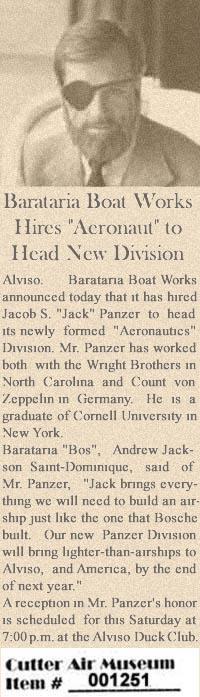
 [10] The clipping (right) is from the Alviso (California) Advocate
and was found in one of 12 boxes of old company records recently
donated by Barataria Industries to the Cutter Air Museum.
Although the clipping is undated, other company records indicate
that Jack Panzer was hired by the Barataria Boat Works in
November of 1905. A computer analysis of the clipping's
photograph revealed that it is the same man as in the photograph
with Jake Cutter.
[10] The clipping (right) is from the Alviso (California) Advocate
and was found in one of 12 boxes of old company records recently
donated by Barataria Industries to the Cutter Air Museum.
Although the clipping is undated, other company records indicate
that Jack Panzer was hired by the Barataria Boat Works in
November of 1905. A computer analysis of the clipping's
photograph revealed that it is the same man as in the photograph
with Jake Cutter.
[11] I have
interviewed two persons who recalled being in the Monkey Bar
when this photograph was taken. (Unfortunately, my copy of those
interviews--along with other documents studied in preparing this
article--has been temporarily misplaced in my recent,
unanticipated move from the Seiber Islands to the Marivellas.)
They each also confirmed that the man's name was Jack Panzer and
that he and Jake Cutter spent a great deal of time together over
the course of at least 2 or 3 days. They report that he arrived
in a flying boat similar to the Pan Pacific Clipper (i.e., a Barataria
Bonavista [Dead
Link, see current Link]) but painted a flat black with the
following name painted in pale grey: "Barataria Black Bird"!
Their recollections are undoubtedly remarkably clear and
credible due to Jack Panzer's tragic disappearance on the flight
of this aircraft from the Marivellas to Guam. The date of his
departure can be accurately fixed since he loudly (and perhaps
unfortunately) announced his intention to fly to Guam to join
the Pan American Hawaii Clipper which coincidentally
happened to have "disappeared" on July 29, 1938. (An
"alternative" explanation of the Hawaii Clipper's so-called
"disappearance" is found in the book Fix on the Rising Sun:
The Clipper Hi-jacking of 1938 and the Ultimate M.I.A.'s
by Charles N. Hill or his website [Dead Link, see WAYBACK MACHINE]. Mr.
Hill claims that the Hawaii Clipper was hi-jacked in
flight by renegade officers of the Japanese Navy and diverted to
the Imperial Japanese Navy's Fourth Fleet naval base, at Truk.
There, her fifteen passengers and crew were murdered and
entombed, reportedly face down, within the poured-concrete
foundation slab of the infamous naval hospital, being built on
Unimakur Mountain, at Dublon Island, overlooking the fleet's
Eten Anchorage.)
Ironically, if Jack Panzer's own Bonavista
had not itself disappeared (flying a course over the same
Japanese controlled island--Truk--to which Charles N. Hill
believes the Hawaii Clipper was hijacked) he would have
died anyway on the Hawaii Clipper.
In yet another irony, the old company records
recently donated by Barataria Industries to the Cutter Air
Museum also reveal that Jack Panzer--a long time member of the
Alviso Duck Club--was originally scheduled on the final flight
of the Pan Pacific's Tagataya Clipper which went down in
the ocean between the Marivellas and the Seiber Islands,
presumably due to mechanical failure and was never found.
(However, for information about a Seiber Island's colonial
Department of Commerce report on the loss, click
here [Dead Link, see
current Link]. )
Panzer like, most of the other members of Alviso Duck Club, was
planning to go to the Seiber Islands to participate in the
annual competition of the Seiber Islands Schützenverein
("Shooting Association"). Literally at the last minute, Panzer
was called away to a meeting with representatives of a still
unidentified government and, therefore saved from the fate of
his fellow Duck Club members.